


More than 200 Distributors
Around 1,000,000 Outlets
Nationwide Coverage
Q-B6
(Quatrefolic + Vitamin B6)
Brand Name
Q-b6
Generic Name
(Quatrefolic + Vitamin B6)
Therapeutic Segment
Nutritional Supplements / Vitamins

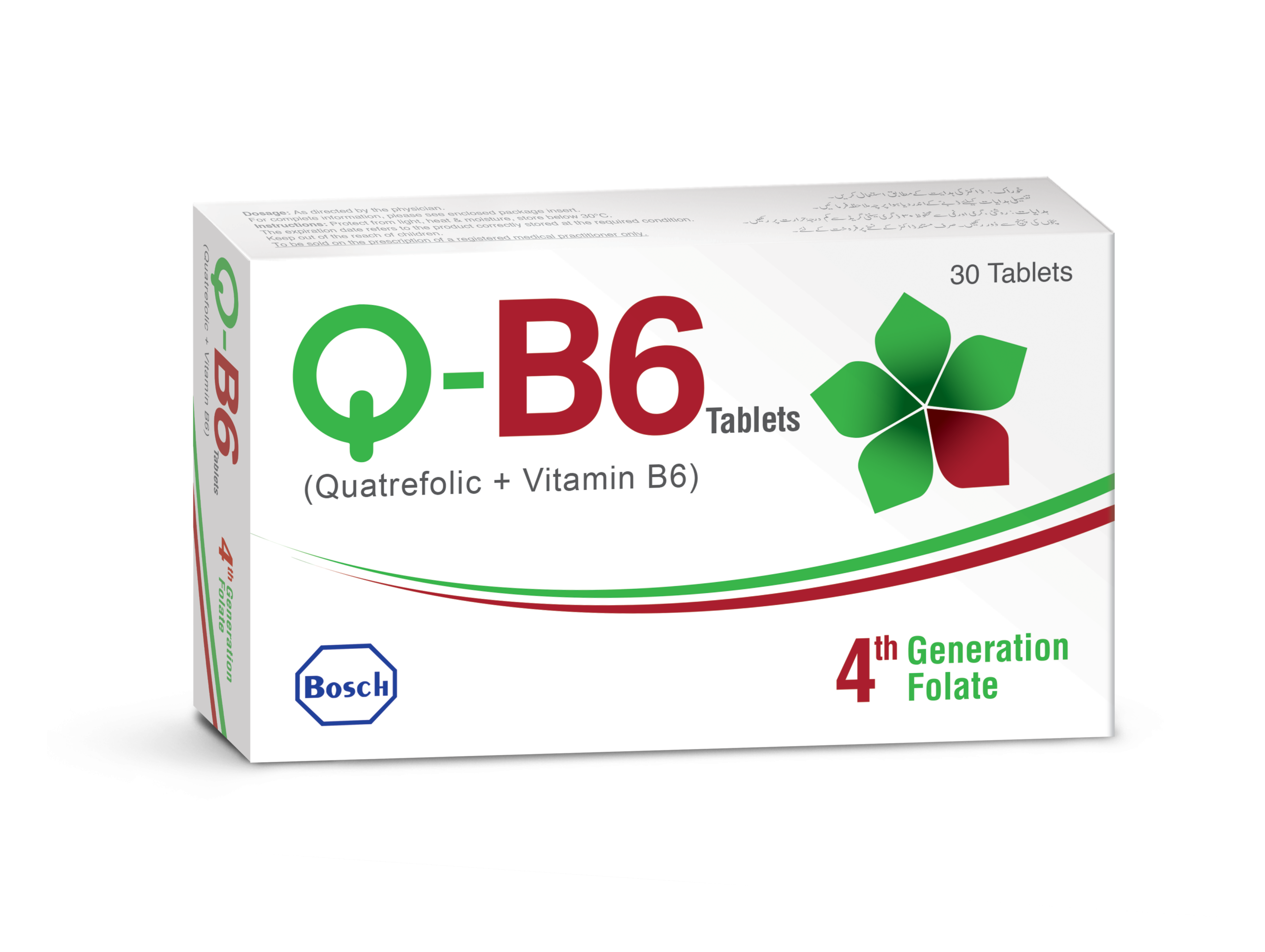
Available as
- TABLET
- Q-B6 TABLET
PRESCRIBING INFORMATION
QUALITATIVE AND QUANTITATIVE COMPOSITION
Q-B6 Tablets
Each tablet contains:
Folate [Quatrefolic 1200mcg as (6S)-5–MTHF, glucosamine salt] (USP)….600mcg
Vitamin B6 (USP)…..25mg
(Manufacturer’s Specs.)
PHARMACEUTICAL FORM
Tablets
CLINICAL PARTICULARS
Therapeutic indications
Q–B6 Tablets contain Folate & Vitamin B6 that are indicated in adults for the following conditions:
- During pregnancy and lactation.
- For pregnant women to prevent neural tube defect in babies.
- As a dietary supplement in adults and older people.
- To prevent risk of spontaneous abortions.
- In postmenopausal women to normalize homocysteine, contributing to helping hot flashes, cardiovascular and bone health of aging women.
- Folate deficiency caused by some medicines (e.g. those used to treat epilepsy such as phenytoin, phenobarbital and primidone)
- Folate deficiency caused by long–term red blood cell damage or kidney dialysis.
- In Depression, Cognitive impairment, Dementia and Alzheimer’s disease.
- For isoniazid–induced peripheral neuritis, idiopathic sideroblastic anaemia and Vitamin B6 deficiency states.
Posology and Method of Administration
Folate (6S)-5–methyltetrahydrofolate:
The intended uses of Quatrefolic and use levels will be same as that of folic acid, expressed on the basis of the Recommended Dietary Allowances for Folate.
- Adult: 400μg daily
- Pregnancy: 600μg daily
- Lactation: 500μg daily
Pyridoxine Hydrochloride (Vitamin B6):
- For deficiency states: 50 to 150mg daily in divided doses for Adults
- For isoniazid–induced peripheral neuritis: 50mg three times daily for Adults
- For idiopathic sideroblastic anaemia: 100 to 400mg daily in divided doses for Adults
Contraindications
- Hypersensitivity to the active substance.
- Long–term folate therapy is contraindicated in any patient with untreated cobalamin deficiency. This can be untreated pernicious anemia or other cause of cobalamin deficiency, including lifelong vegetarians. In elderly people, a cobalamin absorption test should be done before long–term folate therapy.
- Folate given to such patients for 3 months or longer has precipitated cobalamin neuropathy. No harm has occurred from short courses of folate.
- Folic acid should never be given alone in the treatment of Addisonian, pernicious anemia and other vitamin B12 deficiency states because it may precipitate the onset of sub–acute combined degeneration of the spinal cord.
- Folic acid should not be used in malignant disease unless megaloblastic anemia owing to folate deficiency is an important complication.
Special warnings and precautions for use
- Patients with vitamin B12 deficiency should not be treated with folic acid unless administered with adequate amounts of hydroxocobalamin, as it can mask the condition but the sub–acute irreversible damage to the nervous system will continue.
- Caution should be exercised when administering folic acid to patients who may have folate dependent tumors.
- This product is not intended for healthy pregnant women where lower doses are recommended, but for pregnant women with folic acid deficiency or women at risk for the reoccurrence of neural tube defects.
- Taking folic acid supplements might make seizures worse in people with seizure disorders, particularly in high doses.
- Pregnant or breast–feeding women shall consult health care professional before use.
- If symptoms persist or worsen, seek medical advice. Do not exceed the stated dose.
Interaction with other medicinal products and other forms of interaction
- Fosphenytoin: Folic acid along with fosphenytoin might decrease the effectiveness of fosphenytoin for preventing seizures.
- Methotrexate: Folic acid along with methotrexate might decrease the effectiveness of methotrexate.
- Phenobarbital: Folic acid can decrease the phenobarbital effect for preventing seizures.
- Phenytoin: Folic acid along with phenytoin might decrease the effectiveness of phenytoin and increase the possibility of seizures.
- Primidone: Folic acid along with primidone might decrease how well primidone works for preventing seizures.
- Pyrimethamine: Folic acid might decrease the effectiveness of pyrimethamine for treating parasite infections.
- Sulfasalazine can reduce the absorption of folic acid.
- Anti–arrhythmic: Folic acid along with amiodarone might increase the chances of sunburn, blistering, or rashes on areas of skin exposed to sunlight.
Many drugs may alter the metabolism or bioavailability of pyridoxine, including isoniazid, penicillamine and oral contraceptives, which may increase the requirements for pyridoxine. Pyridoxine hydrochloride may reduce the effect of levodopa, a drug used in the treatment of Parkinson’s disease unless a dopa decarboxylase inhibitor is also given.
PREGNANCY AND LACTATION
Folate (6S)-5–methyltetrahydrofolate:
Pregnancy:
Category A. Use in pregnancy is considered acceptable. During pregnancy, women require 5 to 10–fold higher levels of folate for rapid periods of cell synthesis, growth, division and DNA repair associated with embryo growth. Taking 600mcg of folic acid daily is commonly used during pregnancy to prevent birth defects and some neural tube defects.
Lactation:
Folic acid is actively secreted in breast milk. Supplementation in lactating women may be needed if poor nutritional habits lead to maternal deficiency and megaloblastic anemia. No adverse effects in nursing infants have been associated with the use of folic acid during lactation.
Pyridoxine Hydrochloride:
Caution should be exercised when prescribing to pregnant women. No adverse effects of pyridoxine in therapeutic doses on pregnancy or the health of the fetus or newborn child, or during lactation.
Effects on ability to drive and use machines
There is no data about unfavorable influence on the active attention, reflexes & motor activity.
Undesirable Effects
Folate is generally well–tolerated. Gastrointestinal disturbances and hypersensitivity reactions have been reported rarely. However, the administration of high doses can cause the following:
- Gastrointestinal disorders: Anorexia, diarrhea, nausea, abdominal distension, and flatulence.
- Hypersensitivity reactions: Allergic reactions, comprising erythema, rash, pruritus, urticaria, and anaphylactic reactions (including shock).
Long term administration of large doses of pyridoxine is associated with the development of severe peripheral neuritis.
Overdose:
No information available regarding the overdose of 5-MTHF or Pyridoxine (vitamin B6). However, no special procedures or antidote are likely to be needed.
PHARMACOLOGICAL PROPERTIES
Pharmacodynamic properties
Therapeutic classification: Vitamin, Nutritional supplement
ATC Code: B03BB51, A11HA02
Mechanism of Action:
Folate (6S)-5–methyltetrahydrofolate:
The mechanism of action of Quatrefolic is related to the action of 5–methyltetrahydrofolate, the active part of the proprietary ingredient. 5–methyltetrahydrofolate derives from tetrahydrofolic acid, through a series of metabolic reactions.
Tetrahydrofolic acid acts as a coenzyme in several vital metabolic reactions participating in the transfer as acceptors and donors of various one–carbon fragments, involved in the biosynthesis of nucleotides purines and pyrimidines and in the metabolism of several important amino acids.
In concern with vitamin B12, folate coenzymes allow the conversion of the amino acid homocysteine to methionine, the lack of this conversion has been associated with various pathologies and diseases. Conversion of tetrahydrofolic acid to 5–methyltetrahydrofolate is mediated by the action of the enzyme methylenetetrahydrofolate reductase. Supplementation with 5–methyltetrahydrofolate might be preferable to folic acid, being it is immediately available to react with homocysteine to avoid the possibility of hyperhomocysteinaemia.
Pyridoxine Hydrochloride (vitamin B6):
Pyridoxine hydrochloride is Vitamin B6. It is converted to pyridoxal phosphate which is the co–enzyme for a variety of metabolic transformations. It is essential for human nutrition.
Pharmacokinetic Properties
Quatrefolic has a high level of bioavailability and has been shown to achieve a higher peak plasma concentration of 5–MTHF and a greater overall absorption (Area Under the Curve, AUC) compared to both folic acid and the calcium salt of 5–MTHF. It is primarily eliminated by the kidneys via urinary excretion.
Pyridoxine hydrochloride is absorbed from the gastrointestinal tract and is converted to the active forms pyridoxal phosphate and pyridoxamine phosphate. It crosses the placental barrier and appears in breast milk. It is excreted in the urine as 4–pyridoxic acid.
PHARMACEUTICAL PROPERTIES
Incompatibilities:
Not applicable.
Shelf life
As mentioned on pack.
Special precautions for storage
Protect from heat, light & moisture, store below 30°C.
The expiration date refers to the product correctly stored at the required condition.
Keep out of the reach of children.
To be sold on the prescription of a registered medical practitioner only.
Nature and contents of container
Alu Alu blister packs of 3×10’s Tablets
REGISTRATION HOLDER/MARKETING AUTHORIZATION HOLDER
Bosch Pharmaceuticals (Pvt.) Ltd.
Plot no.221-223 , Sector 23, Korangi Industrials Area Karachi-Pakistan.
MANUFACTURER
SHMZ Labs & Pharmaceuticals (Pvt.) Ltd.
101-Sundar Industrial Estate, Lahore
Product Enlistment No.: C-136082
Manufacturer Enlistment No.: 00231
DATE OF REVISION OF THE TEXT.
24-11-2025
Nutraceutical – Not for treatment of any disease